Friday, 31 October 2014

Artist Analysis: Andrew Tift

Andrew Tift
Tift was born in 1968, studied at Stratford College of Art and the University of Central England. This was where he graduated with a first class degree and a Master of Arts degree. So far he has been exhibited in the B.P. Portrait Gallery ten times; he has also won various awards, including The European  Painting Award and the Emerson Group Award, he has also done many notable commissions, for example, the portraits of Neil and Glenys Kinnock.
He describes himself  as a figurative realist painter and that specialises in portraiture. His work is aimed to convey people in a highly detailed and realistic way that is understanding, sympathetic and intimate towards them.
Instead of his paintings, I am going to focus on his drawings, which are mostly the mediums charcoal and graphite on paper. Tift's drawings/work is inspirational to me and they are pieces of work that I aspire too, I believe that they will help me to improve my skills and techniques.

Examples of Andrew Tift's work:
Absorb, a Charcoal Drawing
Absorb 60 cm. x 44 cm. Graphite, Charcoal and Carbon on paper
http://www.andrewtift.co.uk/drawings/absorb.jpg
Unfinished Memory, a Charcoal Drawing
Unfinished Memory 30 cm. x 20 cm. Graphite, Charcoal and Carbon on Paper
http://www.andrewtift.co.uk/drawings/unfinished-memory.jpg


Eric Sykes, by Andrew Tift, 2011 - NPG 6954 - © National Portrait Gallery, London
Eric Sykes by Andrew Tift, (2011) 35 in. x 26 3/8 in. Graphite, charcoal, carbon and ink,
http://www.npg.org.uk/collections/search/portrait/mw220125/Eric-Sykes?LinkID=mp59010&search=sas&sText=andrew+tift&role=art&rNo=1
When I visited a few art galleries in London a couple of years ago, I came across this piece of Tift's in the British Portrait Museum; I can remember being in ore of this striking piece and standing and in front of it and staring in amazement.
The piece show Eric Sykes, who was an actor, comedian, writer, director and producer, who in the piece comes across as happy through his grinning expression and quirky, shown through his slightly off balance spectacles.
The artist has used many formal elements in this piece; personally, the most striking is the tone used, it is strong and there is a lot of contrast between dark and light tones, it is very layered, which creates lots of depth and texture in the piece. The line used gives the piece more shape; also, the simple lines at the bottom that create his shirt, add simplicity to the piece. I am fond of the unfinished look to a finished piece.
I am going to make this piece relate to the work I want to make through including more depth and tone into my work, I also want to incorporate the unfinished look into my work, it makes the pieces more dramatic as more attention is drawn to the bolder parts of the piece, but at the same time, adds simplicity to the piece because of the simple lines.

http://www.bbc.co.uk/arts/yourpaintings/artists/andrew-tift
http://www.npg.org.uk/collections/search/person/mp59010/andrew-tift?search=sas&sText=andrew+tift
http://www.andrewtift.co.uk/drawings.shtml

Thursday, 30 October 2014

Collage

This was my starting point, I decided to make the piece entirely from little pieces of paper which built up to resemble a mosaic, as seen in the pictures below.


After this, I decided that I would approach collage in a different way. I started to tear bigger pieces of paper and layer them which created a completely different texture and look to the piece.
From different perspectives you want see the different layers on the piece and how the shapes are formed.


Charcoal drawing on A1 paper


Similar to the graphite drawing previously, this charcoal drawing is done on an A1 sheet of paper. It is from a small section of a photograph taken by myself. To begin with, I struggled and found the charcoal difficult to work with. Over time this faded away and I adapted different techniques to suit the material. To improve this piece of work more tone could be added in certain areas to bring the composition together.

Wednesday, 15 October 2014

Graphite drawing on A1 paper


Drawing on a sheet of A1 paper in graphite. This drawing shows tone, shape and line. I drew this from a section of picture, of a tree in my house. It shows layers through the use of graphite - layers of graphite that form different tones and shapes. Also the layers of the tree - the leaves overlap and almost get entwined, creating layers of leaves. I found the graphite hard to use at first, however over time my style of drawing adapted and I found that it did not have to be perfect and smooth, and I could infact use rough and sketchy marks.

Tuesday, 7 October 2014

Images of 'Layers'

A wooden structure in my house, the form of the object is interesting and intriguing. It conveys layers through the overlaying of the spikes and the way the light catches it. Layers of light are created due to the different shapes on the structure, it adds intensity to the creases and folds on the object because of it creates more tone in lighter and darker areas. 


These photos show the Yucca tree in my house. The leaves on the tree seem to overlap and intertwine creating a layered effect.  

Pavement that has worn away showing layers through revealing the inside and the surface of the pavement.


These wooden balls show layers due to the pieces of the wood overlaying over one another.

An orchid plant shows layers through the overlapping flowers.


Different creased and scrunched materials illustrate layers through the creases they create and the Layering of the different colours and materials.


Tuesday, 30 September 2014

Examining the idea of layers in the style of Leonardo Da Vinci

The main focus on experimenting and examining layers in the style of Leonardo Da Vinci was on his piece 'Head of a girl'; this piece was chosen because it shows layers in different ways.
Different pencils are layered which created different tones, which then adds more shape and detail to the piece.

I focused mainly on the face to convey how Leonardo Da Vinci uses layers, however incorporated his use of rough sketch marks which also add line and shape to the piece.
Leonardo Da Vinci uses the combination of the layered pencil which creates tone and texture and the mark making: it creates an unfinished look, which applies emphasise on the bolder and more tonal areas of the piece.  

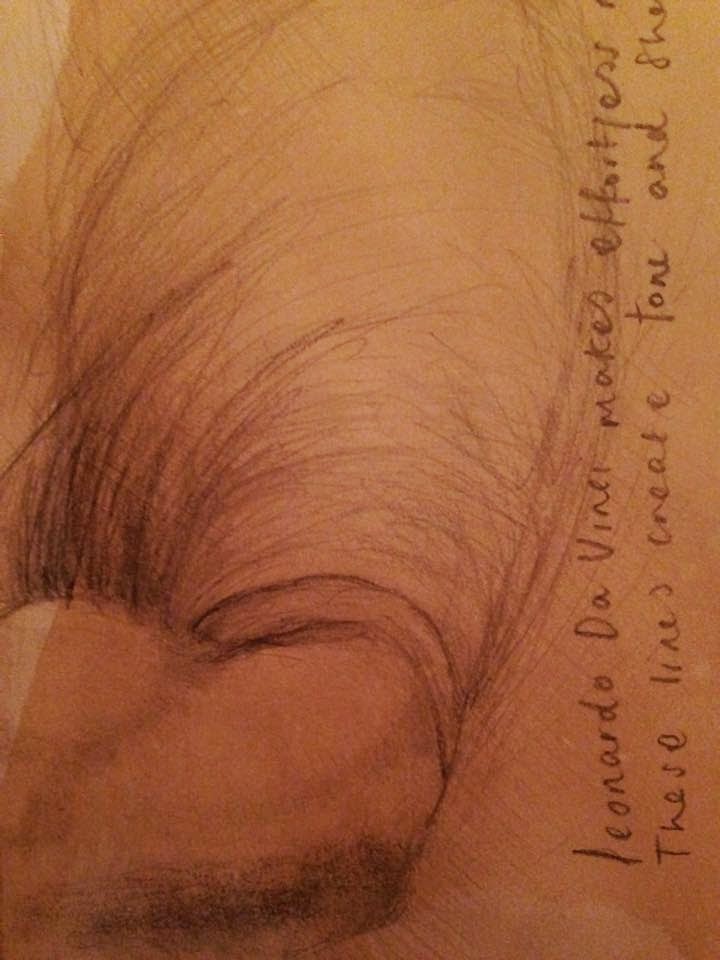
The layers of marks that Leonardo Da Vinci sometimes uses in his sketches are rough and create texture.
I attempted to convey the rough sketches from a section of his piece 'Study of hands'.
Layers are formed when the marks overlap, the line then creates tone and adds shape to the piece.
Also, in some cases, Leonardo Da Vinci annotates on his sketches, this creates layers to the piece due to adding more layers and meaning to the piece.

Wednesday, 24 September 2014

Leonardo Da Vinci

Leonardo di ser Piero da Vinci, now known as Leonardo Da Vinci was born April 15, 1452 near Vinci, a town in Italy. Around 1483 Da Vinci moved to Milan to work as an engineer, painter, sculptor and architect; moving on from his previous job as being an apprentice in Florence to painter and sculptor Andrea del Verrocchio. For two years, 1495 to 1497, Da Vinci worked of the mural 'The Last Supper' in the Monastery of Santa Maria delle Grazie, Milan. In 1499 Da Vinci returned to Florence, in which time he painted several portraits, the famous and only surviving portrait from this period is the 'Mona Lisa'. Sadly, Leonardo Da Vinci died on 2 May 1519 near Amboise in France.

Leonardo Da Vinci was not only an artist; from the discovery of the surviving thousands of pages of his notebooks, it was discovered that he wrote and drew on other subjects including flight, gravity, optics, geology and anatomy(which he used in order to paint the form of the human body more accurately), and also 'invented' the helicopter, aeroplane, parachute and bicycle.
He was a true genius, an artist and scientist; this then made his paintings scientific due to his knowledge of the human body and they show how he understood the world. He influenced and still influences many artists.
Head of a girl c. 1483 - Leonardo Da Vinci - www.leonardoda-vinci.org
'Head of a girl' 1483 - using metalpoint on paper

Studies of human skull - Leonardo Da Vinci - www.leonardoda-vinci.org
'Studies of human skull'


Drawing Of A Womans Torso - Leonardo Da Vinci - www.leonardoda-vinci.org
'Drawing of a Woman's Torso' - ink on paper
Drawing of the Torso and the Arms - Leonardo Da Vinci - www.leonardoda-vinci.org
'Drawing of the Torso and the Arms'
Study of hands - Leonardo Da Vinci - www.leonardoda-vinci.org
'Study of hands' - metalpoint on paper